





Scaffolding Foundation Models into Physical-World Agents Pushes the Frontier of Long-Horizon Navigation

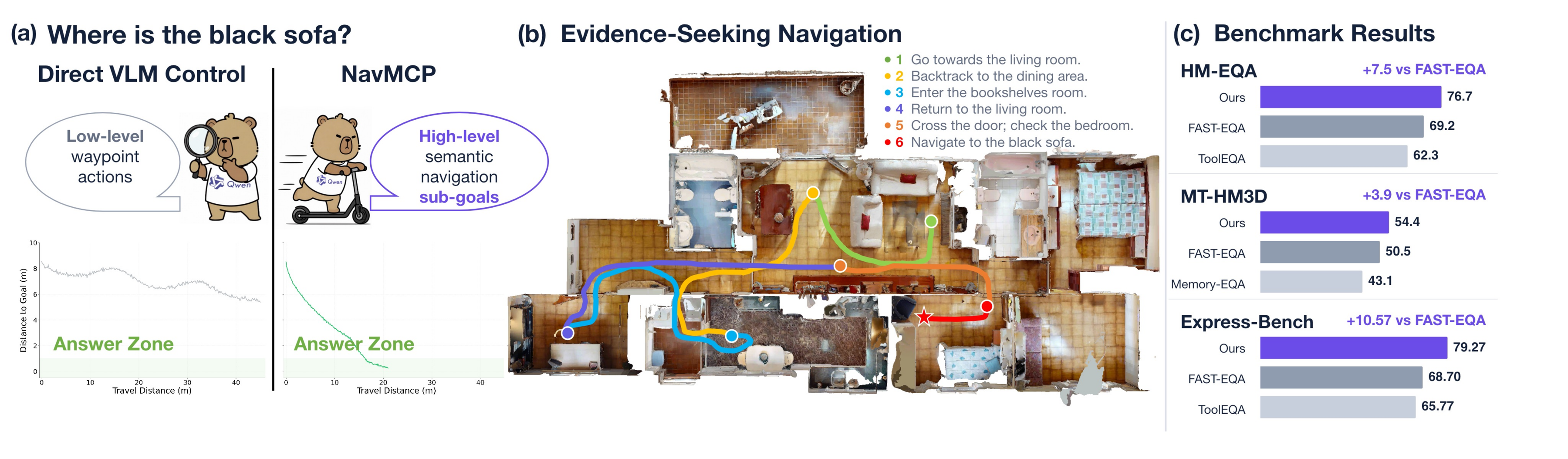
NavMCP scaffolds a Vision-Language Model (VLM) and a Navigation Foundation Model (NFM) into a long-horizon physical-world agent through intent, observation, and memory channels.

Zixing Lei1,3,* Gengze Zhou4,* Xiong-Hui Chen2,* Jiazhao Zhang5 Yiyang Huang2 Hang Yin6 Haoqi Yuan5 Qi Wu4 Weixin Li3 Siheng Chen1

1Shanghai Jiao Tong University 2Qwen Team, Alibaba Inc. 3Zhongguancun Academy 4AIML, Adelaide University 5Peking University 6Tsinghua University

*Equally contributed.
Shanghai Jiao Tong University
Qwen Team, Alibaba Inc.
Zhongguancun Academy
Adelaide University
Peking University
Tsinghua University
76.7%HM-EQA accuracy
79.27EXPRESS LLM Score
78.3%Real-robot success
3Protocol channels

01 · The premise

Two complementary models.
One long-horizon agent.

“The central challenge is not simply to build a stronger reasoner or navigator, but to organize their complementary capabilities into persistent physical-world agency.”

VLMs can infer missing information and adapt high-level plans, but grounding every decision into navigation is brittle. NFMs execute semantic goals robustly, yet typically operate as bounded episodes without persistent task-level reasoning.

NavMCP closes this episodic interface gap with an evidence-centric scaffold that turns isolated navigation rollouts into persistent embodied interaction—without retraining either foundation model.

NavMCP overview comparing episodic and evidence-centric navigation interfaces
Figure 1 A VLM reasons about missing evidence while the NFM executes semantic navigation goals over long horizons.

02 · The scaffold

Three channels.
One persistent interaction loop.

Each channel resolves one failure mode at the agent–executor boundary.

01

From evidence needs to navigation calls

Express intent—not low-level controls.

The agent converts a missing-evidence hypothesis into a semantic call with a mode, natural-language sub-goal, budget, and constraints. The NFM remains responsible for the route.

navigate_to_objecttarget: “small black sofa”budget: 120 steps
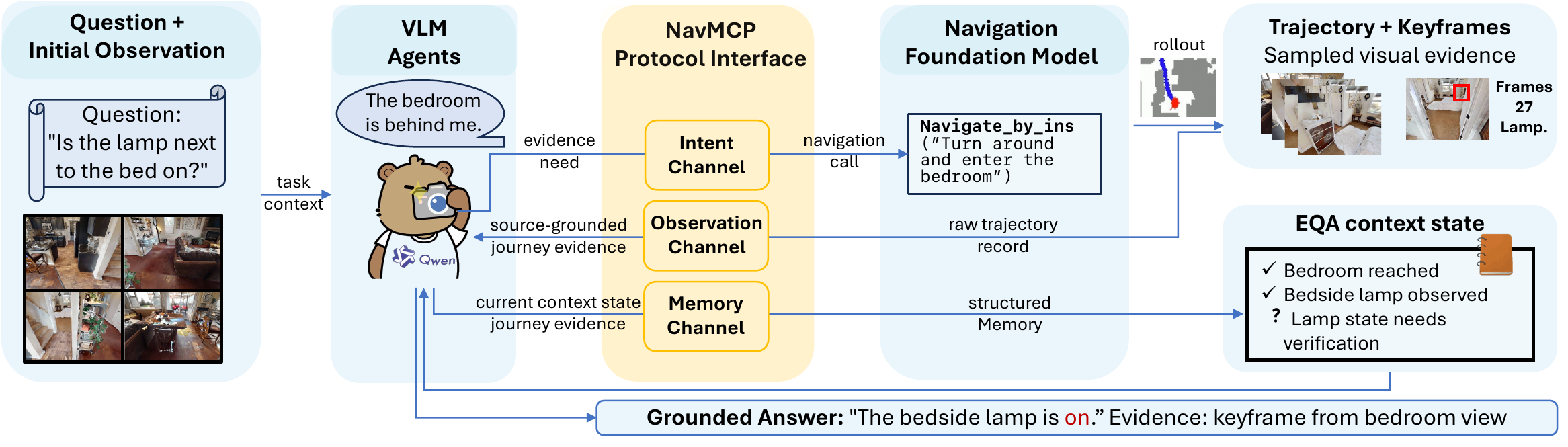
End-to-end NavMCP system architecture
System overview The NFM extends the VLM’s action horizon, while the VLM agent extends the NFM’s reasoning horizon.
01

Ask what evidence is missing.

The VLM turns the question and current view into an explicit evidence need.

02

Navigate with semantic intent.

NavMCP delegates a grounded sub-goal while the NFM handles local execution.

03

Keep the journey as evidence.

Trajectory keyframes preserve what was seen, where it appeared, and what remains uncertain.

04

Update memory, then answer.

Accumulated positive and negative evidence supports the next search or a grounded final response.

03 · Evidence across benchmarks

State of the art across
three EQA regimes.

Results cover single-question search, multi-target reasoning, and free-form embodied QA.

HM-EQA76.7%

+7.5 points over FAST-EQA

MT-HM3D54.4%

+3.9 points over FAST-EQA

EXPRESS-Bench79.27

+10.57 LLM Score

Path efficiency33.96

+4.71 Epath

Matched HM-EQA comparison

Same agent. Same budget. Better interface.

Accuracy (%)
Explore-EQA
57.6
ToolEQA
60.8
FAST-EQA
63.5
NavMCP
74.0
Qwen3.5-397B-A17B agent; matched episodes, initial states, and budget.

Episodic interface gap

What gets lost when the journey disappears?

74.0%full scaffold−14.9 pp59.1%episodic return
  • Intent one navigation mode −2.0
  • Observation terminal-only view −5.9
  • Memory no EQA context state −4.6
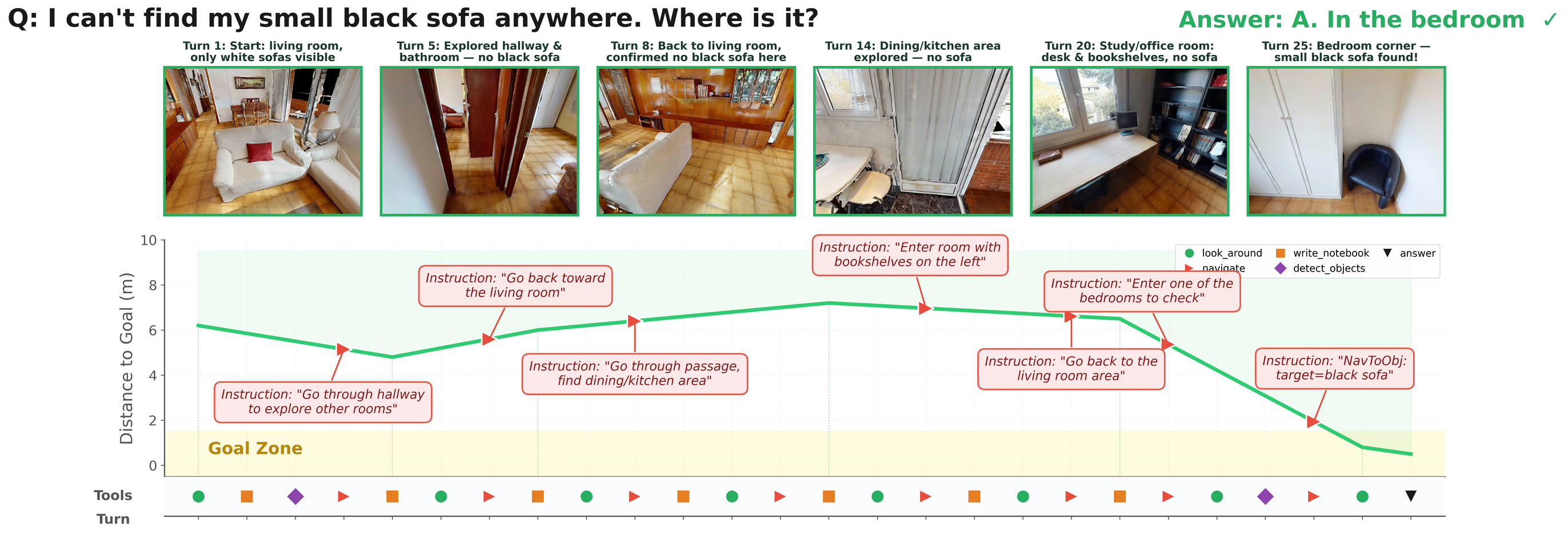
Evidence-guided search episode showing room exploration, goal distance, and tool-call timeline
Evidence-guided search The route is deliberately non-monotonic: the agent rules out five rooms before an object-targeted final call.

Experiment 01 · Embodied question answering

Watch evidence seeking unfold.

The agent moves beyond the initial view, selects semantic navigation goals, and gathers the visual evidence needed to answer.

04 · Beyond benchmark episodes

From long-horizon navigation to
physical-world agency.

The same evidence-centric interface scales from controlled EQA to extended real-world execution and open-ended assistant scenarios.

Experiment 02 · Long-horizon deployment

Stay coherent across spaces, detours, and delayed evidence.

A Unitree Go2 follows a long semantic route toward a coffee shop using a lightweight map while the agent monitors progress and revises its search.

Low · single room90%+10 pp
Medium · cross room85%+25 pp
High · over 20 m60%+45 pp
Overall78.3%60 episodes
Extended real-world navigation · 3× speed03:32
Long-horizon case. The robot traverses multiple public spaces, preserves progress across navigation calls, and grounds arrival at the target location.

Experiment 03 · Future-facing scenarios

Navigation becomes one capability inside a physical-world agent.

Beyond a benchmark question, users can delegate open-ended goals while the agent coordinates reasoning, evidence seeking, movement, and a grounded response.

Scenario reel · 2× speed · 02:02 Real-world demonstrations connect natural-language requests to persistent robot execution.
01

Delegate naturally

Express a goal in language rather than specifying waypoints or control sequences.

02

Act in open spaces

Combine global reasoning with a navigation foundation model that handles local motion.

03

Return grounded help

Preserve journey evidence so the final response reflects what the robot actually observed.

05 · Read & cite

Read and cite
NavMCP.

Read the full paper for the agentic scaffolding framework, evaluation protocols, controlled ablations, and additional qualitative cases.

Open paper
BibTeX
@article{lei2026scaffolding,
  title   = {Scaffolding Foundation Models into Physical-World
             Agents Pushes the Frontier of Long-Horizon Navigation},
  author  = {Lei, Zixing and Zhou, Gengze and Chen, Xiong-Hui
             and Zhang, Jiazhao and Huang, Yiyang and Yin, Hang
             and Yuan, Haoqi and Wu, Qi and Li, Weixin
             and Chen, Siheng},
  year    = {2026}
}